
Gong vs. Chorus: Which platform is better for your team?

Table of Contents:
.png)
If you're evaluating Gong and Chorus, you're probably looking for more than an AI meeting recorder. You want a platform that helps your team coach reps, inspect deals, improve forecast accuracy, and capture customer insights without adding more manual work.
Both companies were founded in 2015 with a similar mission: help sales teams get more value from customer conversations using AI. In their early years, both positioned themselves as conversation intelligence platforms, a category that quickly became essential for B2B sales organizations.
Around the end of 2019, Gong shifted its positioning toward Revenue Intelligence as it expanded beyond conversation analysis into pipeline visibility, deal inspection, forecasting, and coaching. Chorus continued to focus on conversation intelligence before becoming part of ZoomInfo's broader revenue platform.
Today, both products share many core capabilities, including AI meeting summaries, conversation analytics, coaching, CRM integrations, and deal visibility. The biggest differences come from how each platform has evolved and where they continue to invest.
This guide compares Gong and Chorus across the areas that matter most, including product capabilities, ease of use, pricing, and long-term fit, so you can decide which platform is the better choice for your team.
The key difference between Gong and Chorus
It comes down to where each platform has invested over the past few years.
Both Gong and Chorus launched in 2015 with the goal of helping sales teams learn from customer conversations. Recording calls, transcribing meetings, and analyzing conversations are still core parts of both products.
Since then, Gong has expanded into forecasting, deal inspection, AI coaching, CRM automation, and revenue analytics.
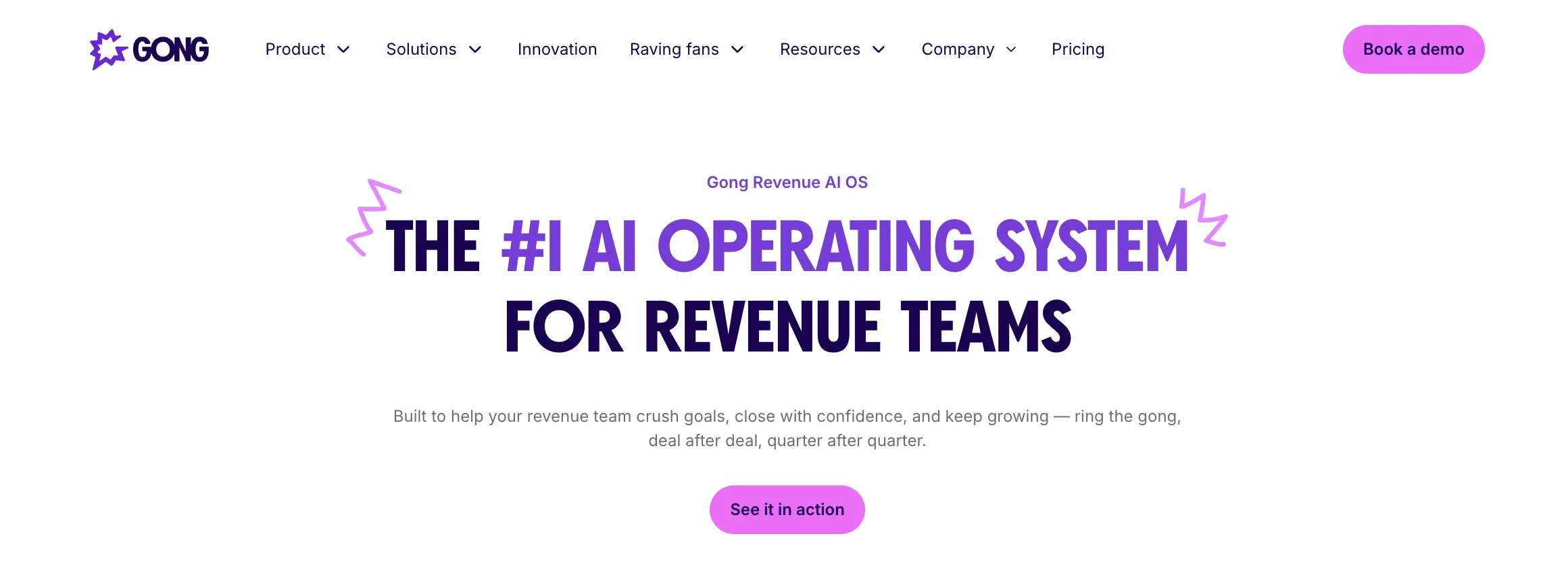
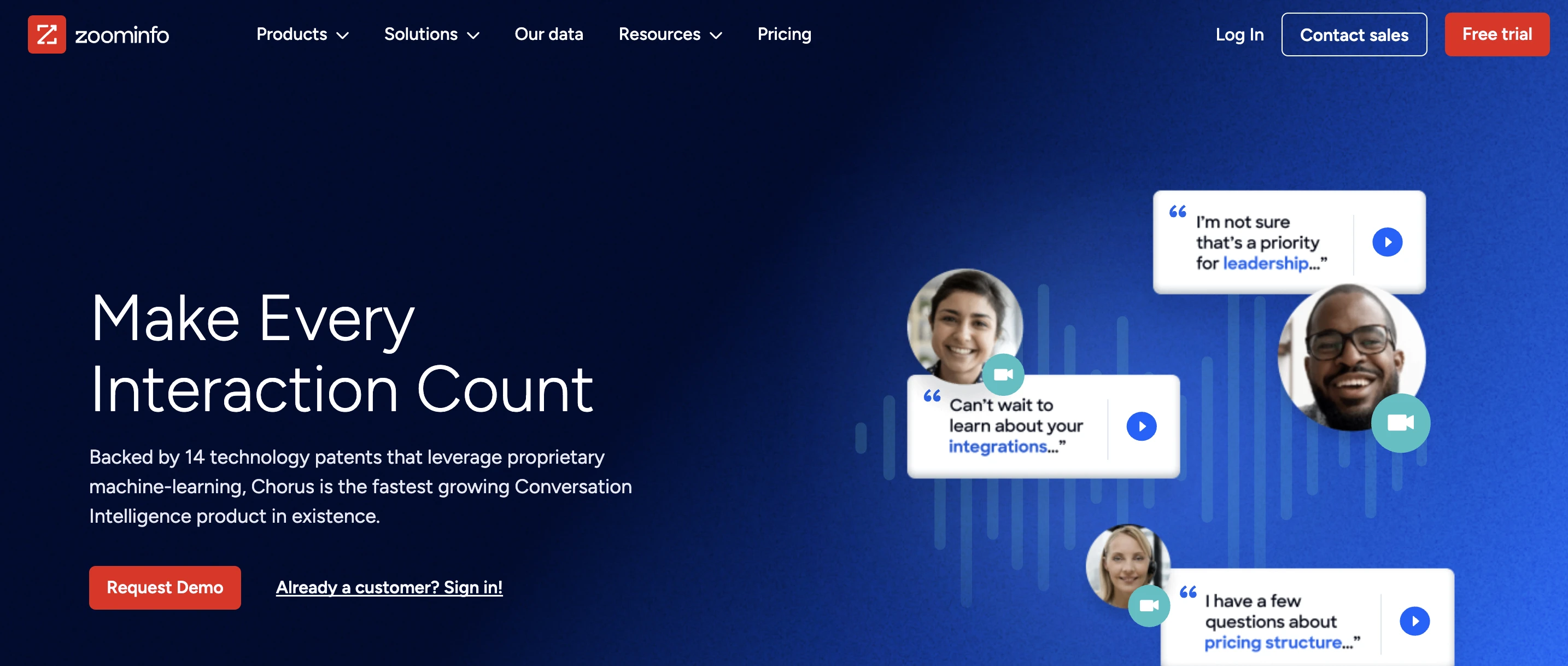
Chorus has evolved as part of ZoomInfo's platform, combining conversation intelligence with buyer intelligence, contact data, and sales workflows.
That raises a few important questions:
- How different are Gong and Chorus today?
- Which platform is better for coaching and pipeline visibility?
- How do their AI capabilities compare?
- Which one is the better fit for your team?
Let's start by looking at what conversation intelligence software has evolved into today.
What is Conversation Intelligence Software?
A conversation intelligence software typically records, transcribes, and analyzes customer and prospect conversations. The software allows sales reps, account managers, and customer success managers to gain deeper visibility into their conversations and learn how to improve those conversations.
The foundation of these softwares is to record calls and meetings and use artificial intelligence (AI), convert speech into text, and then do more advanced analysis on the raw test. Thus by default, all products featured in this category include call recording and transcription capabilities.
But since email is a key channel for sales conversations, these platforms also analyze email content these days.
Using natural language processing (NLP), these platforms analyze conversations to identify topics discussed, talk patterns, questions asked, customer objections, sentiment, and more.
Using these insights, sales leaders can:
- Get visibility across all conversations to make data-driven coaching recommendations
- Identify the best talk patterns that the team should adopt to increase quota attainment
- Proactively learn issues in deals and accordingly guide the team to improve win rate
- Coach and onboard their team continuously in a lot lesser time
If you'd like a deeper look at how conversation intelligence works, how it differs from AI meeting assistants, and what features matter most, read our complete guide to Conversation Intelligence.
What is Revenue Intelligence Software?
Revenue Intelligence software is an evolution of the Conversation Intelligence movement. With Revenue Intelligence, the scope isn't just limited to analyzing sales and customer conversations but spans across capturing and analyzing marketing activities.
Most B2B organizations face a common pain point – lack of alignment between marketing, sales, and success teams. Furthermore, the misalignment typically extends to a lack of seamless integration between the tools used by marketing, sales, and success tools, thus impacting end-to-end visibility.
Revenue Intelligence software solves this problem by automatically collecting and analyzing data across all your customer-facing teams and making it accessible with actionable insights to other teams. This approach empowers all revenue teams to collaborate and strategize faster on revenue growth initiatives.
Let's look at what data and activities Revenue Intelligence softwares need to track across different teams and what actionable insights it needs to provide to different teams:
Activities to track
Marketing
- Site visits, website interactions, and content downloads
- Marketing email opens, clicks
- Chat on website
Sales
- Cold outbound emails and replies
- Outbound and incoming calls
- Prospect meetings
- Contact profile and engagement
- Deal activity and changes
Success
- Customer emails
- Customer meetings and calls
- Support tickets
- NPS Survey feedback and reviews
Intelligent insights to provide
Marketing
- Gaps in the buyer journey and prospect's common objections
- Which messaging resonates the most with buyers
- Competitive intelligence
- Product/Feature demand intelligence
Sales
- Insights from prospect calls and meetings for talk patterns, topics, and next steps.
- Insights from prospect emails for objections, purchase interest, action items, and more.
- Coaching recommendations for Sales reps
- Deal progression, risks and warnings, and suggestions for next action
- Forecasting predictions
Success
- Insights from customer call and meetings for talk patterns, topics, and next steps.
- Insights from customer emails for bugs, feature requests, action items, and more.
- Coaching recommendations for CSMs
- Upsell opportunities and customer churn warnings
Comparing Gong and Chorus
Both Gong and Chorus started as conversation intelligence platforms, helping sales teams record calls, analyze conversations, and coach reps using real customer interactions.
Today, both products cover much more than conversation analysis. They include AI-generated meeting summaries, deal insights, CRM integrations, coaching tools, and pipeline visibility. If you're comparing them today, the decision is less about core functionality and more about how each platform approaches revenue execution.
Gong: Built around revenue execution
Gong has expanded from conversation intelligence into a broader Revenue AI platform. Alongside call analysis, it includes forecasting, deal inspection, pipeline analytics, AI coaching, CRM automation, and workflow recommendations. The platform is designed primarily for enterprise sales organizations that want a single system to monitor pipeline health, coach sellers, and improve forecast accuracy.
Chorus: Part of the ZoomInfo platform
Since joining ZoomInfo, Chorus has become one part of a larger go-to-market platform. In addition to conversation intelligence, teams can connect meeting insights with ZoomInfo's buyer intelligence, contact data, account research, and sales workflows. It's a natural fit for organizations that already rely on ZoomInfo throughout their sales process.
Where they overlap
Both platforms support the capabilities most revenue teams expect today, including:
- Meeting recording and transcription
- AI-generated summaries and action items
- Conversation analytics
- Sales coaching
- CRM integrations
- Deal and pipeline visibility
Where they differ
The biggest differences come down to platform strategy.
Gong has invested heavily in Revenue AI, forecasting, and sales execution workflows. Chorus continues to build on its conversation intelligence foundation while benefiting from ZoomInfo's data and prospecting ecosystem.
We'll look at those differences in more detail throughout the rest of this guide.
How to choose between Gong and Chorus
Both companies are market leaders, have raised hundreds of millions of funding, have thousands of customers and glowing reviews on Software review sites, have pretty comparable offerings from a product and functionality perspective.
Given all this, it’s difficult to choose between the two. That’s why we’re here to help.
But before pulling the trigger to choose between two, let’s first understand how to evaluate these tools.
Key factors for evaluation
1. Ease of use
This is arguably one of the most important aspects of the solution, as it will make or break adoption of the platform among your organization.
Questions to consider:
- Is the tool hard to set up and implement? Do you need a dedicated manager to administrate the tool?
- Is there a self-serve option to try it out yourself, or the only option is talk to the sales team, get the training for your end-users and admins?
- Does the tool benefit ongoing basis only to a handful of people, or everyone who is using it?
- Will you see excitement and higher adoption initially when the insights are new, or will it also get used after 90-days once people know what’s their Talk-time ratio, who are common competitor mentions, etc.?
2. Product functionality
This is probably the second most important aspect of evaluating the solution, to check if they offer comprehensive and comparable functionality.
Questions to consider:
- How comprehensive is the product functionality and features?
- What integrations do they support? Do they support natively or via some 3rd party API connectors?
- What functionality is flexible, customizable, etc.?
- What are your needs? Do you need all the bells and whistles?
3. Pricing
This is not the most important aspect of making a purchase decision, but everyone wants to buy an affordable solution, that also is the best of breed. And this becomes difficult when both these vendors do not provide public pricing information on their website.
But based on the information shared on public forums like Reddit, they are pretty expensive as they’re targeting Mid-Market and Enterprise customers. And they only offer Annual agreements and there is no monthly billing option.
Questions to consider:
- Do you really need all those functionalities? Is it an overkill at your stage or not?
- Are you going to pay for something that looks fancy, but you are not going to have time to use it actively, etc.?
- Is there a minimum platform fee, initial implementation or set up fee?
- What about ongoing customer success and training? Is there an extra fee?
- Is the pricing affordable, flexible and fair?
4. Future proof
While today a specific solution might serve your current needs for sales coaching and onboarding, have you considered how this solution will fit in for your future needs.
Questions to consider:
- What will happen after the initial reps are onboarded using this tool? What if you’re not planning to hire more reps continuously as a high-growth organization?
- Will this tool scale to other functions in the organizations if the need arises for the Product, Marketing or Recruiting teams to record and transcribe their meetings?
That said, let's now look at Gong and Chorus specifically.
Evaluating Gong and Chorus: Step by step
Both Gong and Chorus are mature enterprise platforms with thousands of customers and years of product development behind them. They also overlap across many core capabilities, which makes comparing feature lists alone less helpful.
The better approach is to evaluate them based on the areas that will have the biggest impact on your team after implementation. Adoption, coaching workflows, AI capabilities, CRM integrations, pricing, and long-term fit often matter more than the number of features on a comparison page.
Here's how we'd evaluate both platforms.
The TL;DR version
Chorus positions itself as a Conversational Intelligence platform focusing on building stronger relationships and acquiring unbiased market intelligence, whereas Gong is all about sales coaching and revenue intelligence. Both the tools are appreciated by their customers and are also known for being enterprise-oriented.
1. Ease of use
Even the best sales platform won't deliver much value if your team doesn't use it consistently. Ease of use isn't just about having a clean interface. It affects implementation time, rep adoption, manager engagement, and how quickly your team starts seeing results.
As Gong and Chorus have expanded their platforms over the years, they've added forecasting, coaching, AI capabilities, and revenue workflows. Those additions make the products more capable, but they also increase the learning curve for admins and end users.
Questions to consider:
- How long does implementation typically take?
- How much admin effort is required to configure and maintain the platform?
- How quickly can new reps become productive?
- Does the product fit naturally into your team's existing workflow?
- Will managers, RevOps, and sales reps all use it regularly, or will adoption be limited to a small group?
What's missing?
Both Gong and Chorus have grown far beyond conversation intelligence. Along with that growth comes more configuration, more workflows, and a broader feature set to learn.
For large enterprise sales organizations, that's often a strength. Teams can standardize coaching, forecasting, and pipeline inspection in a single platform.
Smaller teams may have a different experience. If your primary goal is AI meeting notes, coaching, or CRM automation without a lengthy implementation, it's worth considering how much of the platform you'll actually use.
Ease of use isn't about having fewer features. It's about helping every user get value from the product without adding unnecessary complexity.
If you're looking for AI meeting notes, conversation intelligence, coaching, and CRM automation in a platform your team can adopt quickly, take a look at Avoma.
It gives revenue teams the capabilities they use every day without requiring a long implementation or extensive admin overhead.
2. Product functionality
Gong and Chorus share many of the capabilities buyers expect from enterprise conversation intelligence platforms. Both record meetings, transcribe conversations, analyze calls, integrate with major CRMs, and help managers coach their teams using real customer interactions.
The differences become more noticeable once you look beyond those core capabilities.
Gong
Gong has expanded well beyond conversation intelligence into a broader Revenue AI platform. Along with meeting recording and conversation analysis, it includes deal inspection, pipeline visibility, forecasting, AI coaching, CRM automation, and revenue analytics.
Its product is built around helping sales leaders understand what's happening across their pipeline, identify deal risks early, coach reps using real conversations, and improve forecast accuracy.
Gong also continues to invest heavily in AI capabilities, including automated insights, AI-generated summaries, recommended next steps, and workflow automation that reduce manual work for sales teams.
Call recording and analytics: Gong records calls, transcribes and analyzes your calls so that you get insights from the call in minutes after your call ends. These insights typically tend to be the next steps (action items from the call), competitor mentions, and more.

Deal intelligence refers to having visibility into your sales pipeline where you understand the interactions between your reps and your prospects/customers. It's about being proactive in potential risks and making sure you don't lose a deal from your pipeline.

People intelligence refers to identifying people who are crushing it and identifying patterns as to what's working for them. When you identify that, it becomes easy to build personalized coaching programs.

Market intelligence refers to understanding how customers and prospects are reacting to the business ecosystem you operate in. It could mean tracking competitor mentions on a call (whom they compare your product to), feedback on customer experience, sales and marketing plays and more.

Chorus
Chorus remains centered around conversation intelligence, but it has grown significantly since becoming part of ZoomInfo.
In addition to recording and analyzing meetings, Chorus combines conversation insights with ZoomInfo's contact data, account intelligence, buyer signals, and sales workflows. Teams already using ZoomInfo can access conversation data alongside prospecting and account research without switching platforms.
Like Gong, Chorus supports AI-generated meeting summaries, coaching workflows, conversation analytics, CRM integrations, and deal visibility across the sales cycle.

Deal visibility: Chorus offers a deal hub where you could get a single source of truth about all customer conversations and the pipeline. It gives you an understanding of the complete context of all calls and conversations from a deal maturity and risk standpoint.

Momentum: This is similar to Gong’s Deal Intelligence functionality, where you’ll know each deal activity and pinpoint exactly what interactions impact deal progression. This is helpful to forecast and find next actionable opportunities.

Market Intelligence: It refers to understanding the first-hand intelligence captured from the calls that give you an insight into the customer's voice, who your customer thinks as your closest competition, what features of your product do customers appreciate the most, etc.

What’s missing?
Both Gong and Chorus automatically generate meeting summaries, action items, and follow-up insights. Those capabilities have become standard across enterprise conversation intelligence platforms.
Where teams often see differences is in how meeting knowledge is captured, organized, and shared after the call.
For example, some organizations want structured meeting notes that can be edited collaboratively, standardized with templates, and shared across sales, customer success, product, and leadership teams. Others want meetings to automatically create CRM-ready notes, update records, and become part of a searchable knowledge base.
If collaborative meeting documentation is an important part of your workflow, it's worth comparing how each platform handles note-taking, knowledge management, and cross-functional collaboration, not just conversation analysis.
3. Pricing
Neither Gong nor Chorus publishes pricing on their website, so you'll need to contact their sales teams for a custom quote. Pricing typically depends on factors such as team size, product modules, contract length, and implementation requirements.
Because both products primarily target mid-market and enterprise organizations, buyers should evaluate the total cost of ownership, not just the subscription price.
Gong pricing
Gong uses custom enterprise pricing based on your organization's requirements. Depending on the package you choose, your quote may include additional modules for forecasting, coaching, or other Revenue AI capabilities.
If you're evaluating Gong, ask about:
- Minimum seat requirements
- Included product modules
- Implementation and onboarding
- Professional services
- Contract length
- Future expansion costs

Chorus Pricing
Like Gong, ZoomInfo Chorus is sold through custom pricing rather than a self-service model. Pricing may vary depending on whether you're purchasing Chorus on its own or as part of the broader ZoomInfo platform.
When requesting a quote, it's worth understanding:
- Which ZoomInfo products are included
- Licensing requirements
- Implementation services
- Support and training
- Contract flexibility

What’s missing?
The quoted price is only part of the buying decision.
Enterprise platforms often include implementation, onboarding, training, and additional product modules that can affect the overall investment over time. It's also worth considering how many users need full licenses and whether every team requires access to the same capabilities.
If your requirements are more focused, such as AI meeting notes, conversation intelligence, or coaching, compare the product packages carefully. Paying for capabilities your team won't use can increase costs without adding much value.
Both these solutions don’t offer much flexibility, in terms of pricing as well as usage tiers. And most smart SMB players recognize the gap as well as the need:

Avoma takes a more modular approach. Teams can start with AI Meeting Assistant, then add Conversation Intelligence, Revenue Intelligence, or AI Coaching as their needs grow. That gives smaller teams more flexibility while allowing larger organizations to expand over time.
4. Future proof
Buying a conversation intelligence platform is usually a long-term decision. The platform you choose today should still meet your needs as your sales process, team structure, and AI strategy evolve.
Both Gong and Chorus have expanded well beyond meeting recording and conversation analysis over the past few years. As your organization grows, it's worth considering how each platform supports additional revenue workflows, AI capabilities, and cross-functional collaboration.
Questions to consider:
- Will the platform continue to meet your needs as your sales team grows?
- Can it support multiple revenue teams, including Sales, Customer Success, RevOps, and Enablement?
- Does it integrate with the CRM, meeting platforms, and GTM tools your organization already uses?
- How quickly is the vendor shipping new AI capabilities?
- Will your team adopt more of the platform over time, or only use a small portion of its features?
What's missing?
Growth isn't just about hiring more sales reps. It's also about how your revenue teams work together.
As organizations scale, conversation data becomes useful far beyond frontline sales. Customer Success, Revenue Operations, Enablement, Product Marketing, and leadership teams all rely on customer conversations to understand what's happening across the business.
When evaluating a platform, consider how easily different teams can access meeting insights, collaborate around customer feedback, and turn conversations into actions. The platform that works best for your sales team today should continue delivering value as more teams begin using it.
Because Avoma isn't built solely around sales coaching, revenue teams can extend meeting intelligence across Sales, Customer Success, Product, Marketing, Recruiting, and Leadership without introducing separate tools for each function.
Final verdict
Both Gong and Chorus are mature platforms with thousands of customers and strong reputations in the enterprise market. They share many core capabilities, including conversation intelligence, AI meeting summaries, coaching tools, CRM integrations, and deal visibility.
The better choice depends on what your team needs beyond those fundamentals.
Choose Gong if...
Gong is a strong fit for enterprise sales organizations that want advanced forecasting, deal inspection, AI coaching, and Revenue AI capabilities alongside conversation intelligence. If pipeline visibility, forecast accuracy, and sales execution are top priorities, Gong has one of the most comprehensive platforms in the category.
Choose Chorus if...
Chorus is a good choice for organizations already invested in the ZoomInfo ecosystem. Its conversation intelligence capabilities become more valuable when combined with ZoomInfo's buyer intelligence, contact data, and account insights.
Choose Avoma if...
Avoma is a good fit for teams looking for AI meeting notes, conversation intelligence, coaching, and revenue intelligence in a platform that's easy to adopt across Sales, Customer Success, RevOps, Marketing, Product, and other customer-facing teams. Its modular pricing also gives organizations the flexibility to start with the capabilities they need today and expand as their requirements grow.
Ready to compare all your options?
Gong and Chorus are both strong platforms, and the right choice depends on how your team works, your existing tech stack, and what you expect from an AI-powered revenue platform.
If you're still evaluating your options, see how Avoma compares side by side on conversation intelligence, AI meeting notes, coaching, revenue intelligence, CRM automation, scheduling, and pricing.
→ Compare Avoma vs Gong
→ Compare Avoma vs Chorus
→ Book a personalized demo
Frequently Asked Questions


Dive into Our Latest
Avoma Insights.


What's stopping you from turning every conversation into actionable insights?


