
The AE deal momentum playbook: What to do when a deal stops moving

Table of Contents:
As an AE, you can usually tell when a deal is moving.
The prospect has a clear problem, the right people are involved, and the next step is agreed.
The harder ones are the deals that keep their "active" status long after the momentum has disappeared.
Ever moved the close date and thought, "Okay, but what changed?"
This playbook is built for that moment. Start with the situation that matches your deal, then use the frameworks, questions, and talk tracks to work through what is slowing it down.
Quick glance: What to focus on next
1. Discovery is staying surface-level. How do you go deeper?
Don't use discovery to collect facts you could have learned before the call. Go in with that context already, then use the conversation to uncover the problem underneath and why it matters.
Avoma's analysis of 12,847 sales calls found that top performers asked 40% fewer situational questions and 3x more impact questions than average performers. They also stayed with a pain point longer instead of switching topics or moving to the product too quickly.
"A great discovery isn't about asking more questions. It's about asking better questions in the right sequence."
Aditya Kothadiya, CEO and Co-founder, Avoma
Use the 3-2-1 topic discovery framework
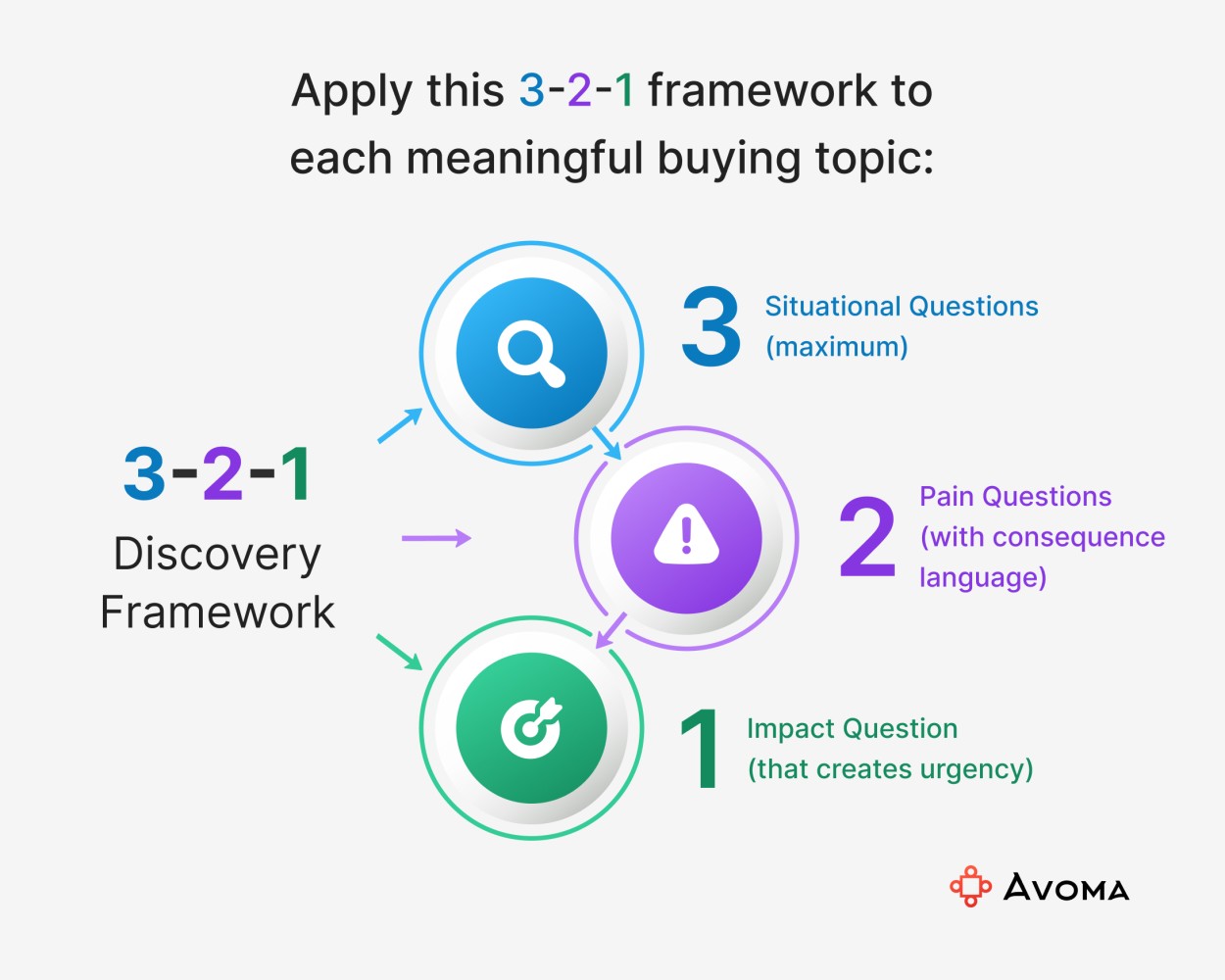
3 Situational questions, maximum
Use research to avoid spending the call collecting information you could have learned beforehand. Confirm the context you need, then move deeper.
2 Layered pain questions
Stay with one pain point long enough to understand its consequences. Anchor the follow-up in something the prospect has already said.
"You mentioned [THING THEY SAID]. What specifically [CONSEQUENCE/CHALLENGE] does that create for [THEIR ROLE/TEAM]?"
1 Impact question
Once the problem and its consequences are clear, connect them to the outcome the prospect wants to achieve.
"If this were solved in the next 90 days, what would success look like for your team? Which metric would move first?"
When another major problem comes up, restart the 3-2-1 sequence around that topic.
If you want to go deeper into discovery, use our sales discovery guide and the 90+ discovery questions that come with it.
2. Your demo feels like a feature tour. How do you make it about the prospect's problem?
By the time you get to the demo, you should already know the prospect's problem, use case, and priorities. Use that context to decide what gets demo time and keep the conversation focused on what they need to evaluate.
Prepare before the demo
Do the basic homework before the meeting so you do not spend the demo asking questions you could have answered yourself. Review the prospect's company, role, current setup, and priorities.
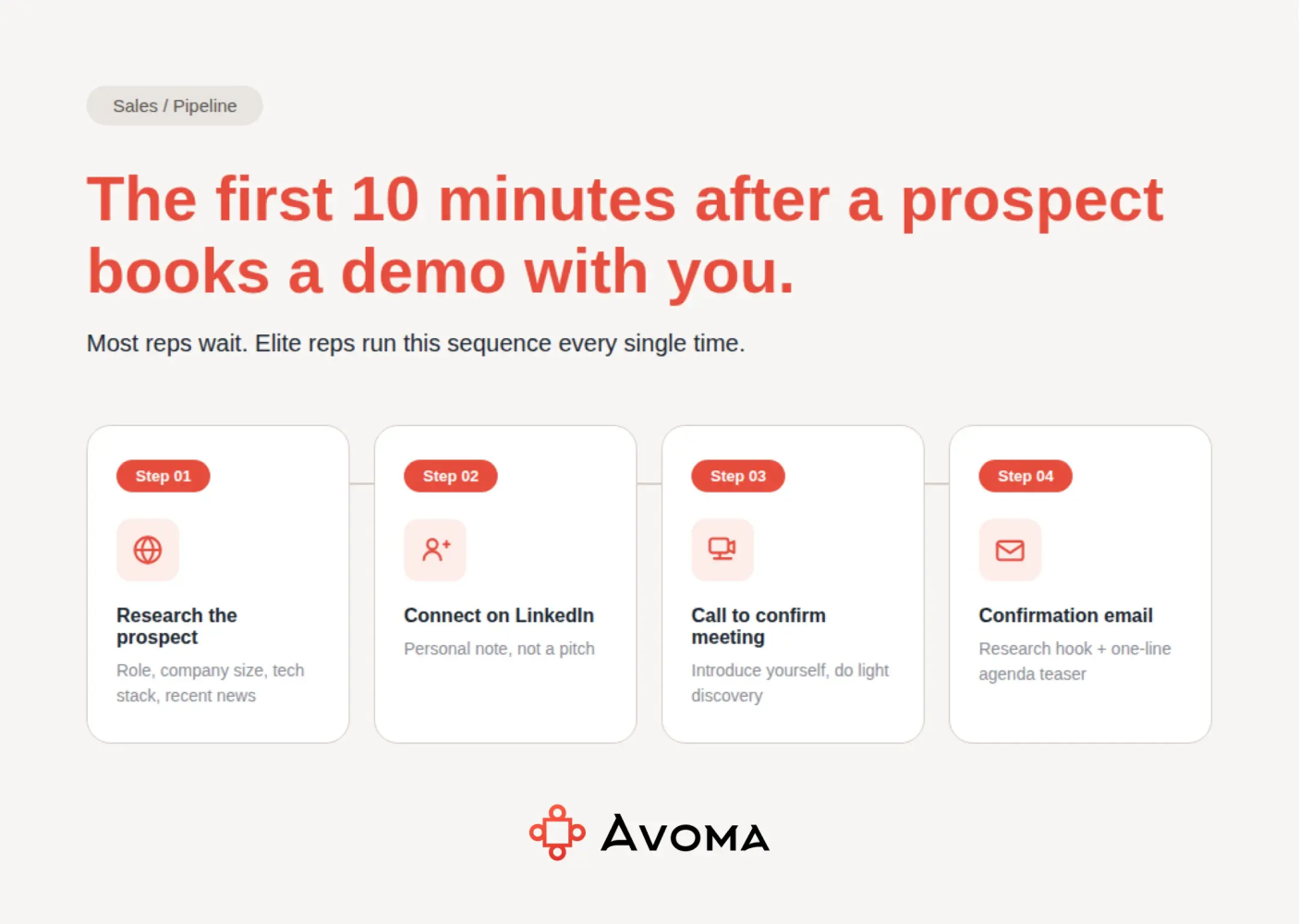
Use what you learned during discovery to decide which parts of the product deserve time during the demo.
The goal is not to walk through the full product. Focus on the capabilities most closely connected to the problem the prospect wants to solve and the outcome they care about. For a full walkthrough, see our guide to running a sales demo that converts.
By the end of the demo, you should have clarity on:
- the problem the prospect is trying to solve
- the outcome they care about
- who is involved in the decision
- what still needs to be validated
- what the next step will be
That gives the prospect a clearer basis for deciding whether and how the evaluation should continue.
Use Ask Avoma to prepare with previous deal context
Ask Avoma is Avoma's AI copilot for meetings, deals, accounts, and pipeline. Before a demo, use it to review what the prospect has already discussed across previous meetings, emails, and deal activity, including their priorities, objections, stakeholders, and unresolved questions.
That gives you the context to decide what deserves demo time without repeating discovery or digging through old recordings.
3. The trial is ending without a decision. How do you move the prospect toward one?
A trial should help the prospect get closer to a decision. If you reach the final days with plenty of product activity but still no clarity on whether they have seen enough value to move forward, go back to how the evaluation was set up.
Check whether success was defined, the right people were involved, and the decision point was agreed from the start.
Three problems usually get in the way:
- No shared definition of success. The prospect does not know what the trial needs to demonstrate, and the rep does not know what would support a decision.
- No structure. Check-ins happen without clear milestones or a defined decision point.
- No diagnosis when progress slips. Delays and extensions continue without clarity on what remains unresolved.
The 5-phase trial system: Build a clear path from evaluation to decision
The five phases keep the evaluation focused, surface problems while there is still time to address them, and prevent the trial from ending in an open-ended request.
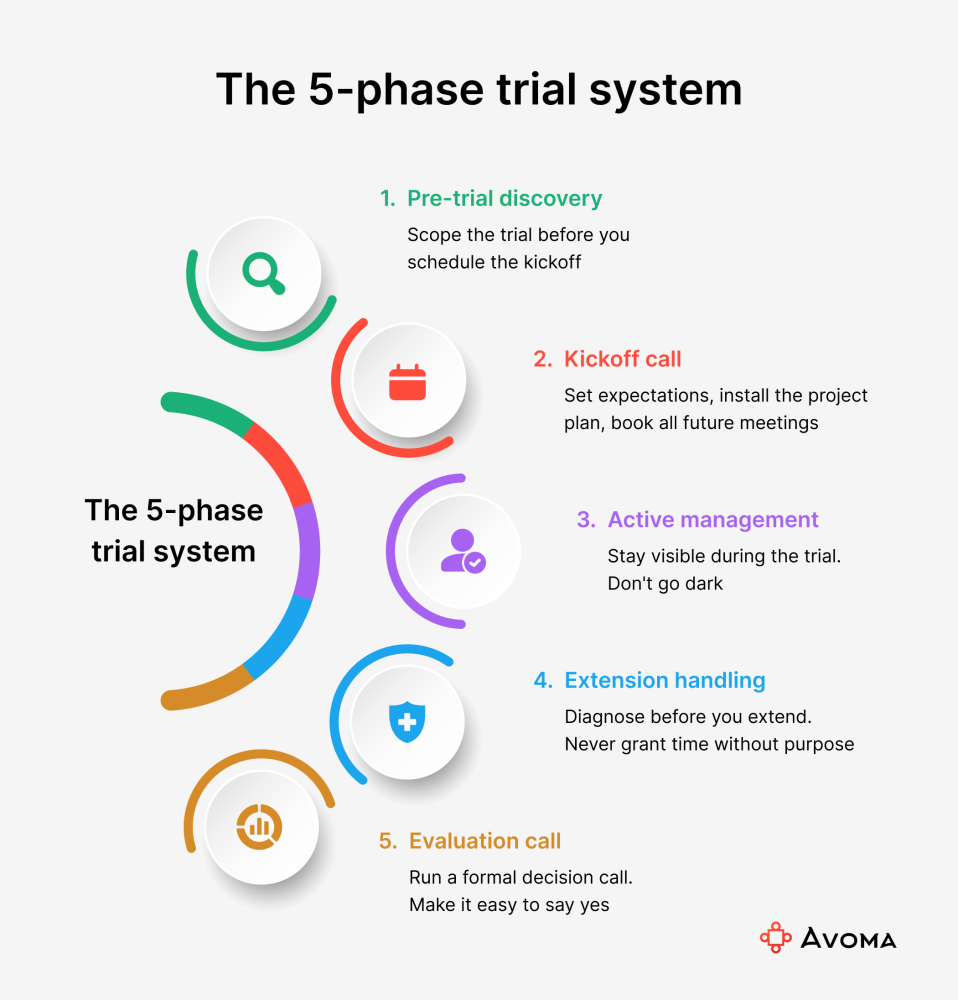
1. Pre-trial discovery
Scope the trial before kickoff.
Define the one or two use cases that matter most. Identify who will use the product, who will judge the outcome, and who can influence or block the decision.
Ask whether the prospect has evaluated similar products before and what stopped them from moving forward. That can reveal what this trial needs to prove differently.
"The questions that actually determine whether a trial succeeds—who's involved, what success looks like, who has veto power—need to be answered before the countdown starts."
Aditya Kothadiya, CEO and Co-founder, Avoma
2. Kickoff call
Bring the right users in from day one and put the key milestones on the calendar:
- admin or technical setup
- end-user onboarding
- mid-trial review
- evaluation and decision call
The final evaluation should already be scheduled when the trial begins.
3. Manage the trial with evidence
Check whether users are active, important workflows are being tested, integrations are working, and the trial is producing evidence the prospect can evaluate.
Bring that evidence into the check-in.
"I reviewed your account before this call. I can see [X] users completed [workflow], and [Y] results are already showing up. I want to walk through what we are seeing and make sure it is useful."
This surfaces setup or adoption problems while there is still time to address them.
4. Diagnose the reason behind an extension
A request for more time should trigger a diagnosis:
- Stakeholder unavailable: Keep the trial running so they return to evidence.
- Usage low: More time will not help unless behavior changes.
- Another use case: Define what still needs validation.
Ask:
"What are we trying to accomplish in the extra time that we did not get done in the first two weeks?"
5. End with a decision
Review what the trial showed, surface remaining concerns, and make sure the relevant stakeholders saw the evidence.
Then ask:
"Based on what we have seen over the last two weeks, does this solve the problem you came in with?"
4. The call is ending without a clear next step. How do you secure one?
We've all heard some version of: "Let us discuss internally." "We will review the options." "We will get back to you."
If your calls keep ending there, the prospect has no clear reason to reconnect. Before the call ends, agree on what happens next, why it matters, and when you'll reconnect.
Plan the next step before the call ends
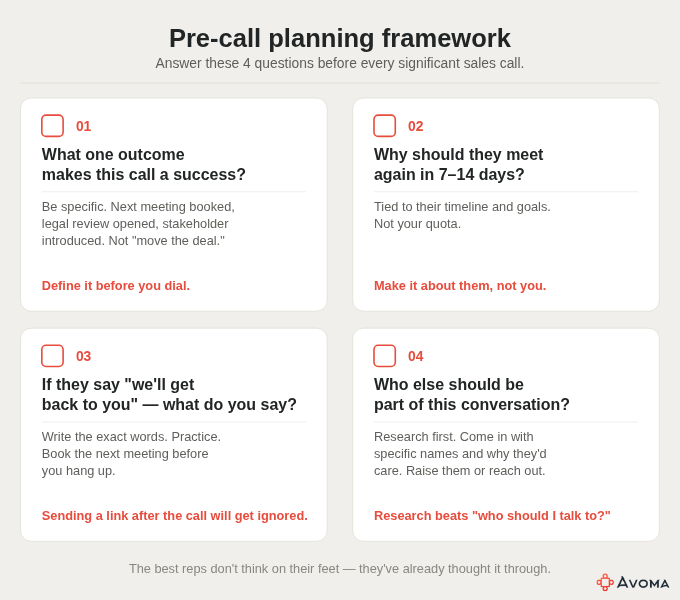
Go into an important call knowing:
- What outcome would make the call successful? Make it concrete, such as booking the next meeting, opening legal review, or bringing in another stakeholder.
- Why should the prospect meet again? Give the next conversation a purpose tied to their evaluation, goals, or timeline.
- How will you respond if they defer? Prepare for "we'll get back to you" before the call.
- Who else should be involved? Identify the stakeholder and why they need to enter the conversation.
Give the next meeting a reason to exist
During a competitive evaluation:
"You're going to see several products, and parts of them may start blending together. Why don't we reconnect after you've seen what's out there? Bring what stood out, and we can compare it against what you need."
When the next conversation already has a clear purpose, reduce the effort required to schedule it:
"I went ahead and blocked some time. Let me know if the timing works. I have a couple of things I want to walk through, and it will be easier to do that live."
A meaningful next step could be bringing in another stakeholder, sharing information, starting a review, or scheduling the next decision point.
Turn the agreed next step into follow-through
Avoma captures commitments and action items from the call, including who owns them, and drafts the follow-up from the conversation. Use it to send the recap with the agreed next step and sync that activity back to the CRM before it gets lost between meetings.
5. The prospect is pushing back on pricing. How should you respond?
Almost all prospects push back on pricing. Before you change the commercial terms, find out what is behind it. Is it budget, value, cash flow, procurement pressure, or a competing offer?
Find the reason behind the pushback
Listen for what sits behind the request:
- "We want to wait." Confidence or timing may still be the issue.
- "We are not sure about adoption." The prospect needs stronger evidence that the product will deliver value.
- "It is a cash-flow issue." Explore payment terms before reducing the contract value.
- "We have cheaper alternatives." Find out what the prospect sees in those alternatives and how much of the objection is driven by price.
- "This is the number procurement gave us." Establish whether the number is a firm finance ceiling or a negotiation target.
For more ways to work through pushback, see our guide to handling customer objections.
Position against alternatives through the prospect's criteria
When another vendor enters the conversation, understand what the prospect sees as different.
Ask about the workflows, capabilities, or outcomes they are comparing so you can understand their decision criteria.
"That is fair. What are you seeing from those alternatives that you are not seeing here? Or is this primarily a pricing comparison at this point?"
Keep the conversation focused on what matters to the prospect rather than turning it into a list of competitor claims.
Adjust the payment terms before you cut the price
Cash-flow pressure may come down to when the prospect pays. An annual commitment with quarterly billing can address that concern while preserving the contract value.
Tie discounts to a stronger commitment
If price needs to move, connect the discount to a longer contract term, higher seat commitment, or broader scope.
This gives the prospect a clear trade-off rather than reducing the price with nothing changing in return.
Test procurement pressure before you react
When procurement presents a lower number, first establish what that number represents:
"Help me understand that number. Is it a firm ceiling from finance, or a target based on what you expected to pay?"
Once you have presented the strongest viable offer, avoid reopening the negotiation without new information from the prospect.
6. The prospect said yes, but the deal isn't signed. How do you move it to signature?
A verbal yes does not mean the deal is ready to sign. Legal, security, procurement, finance, or another internal approval may still be open.
Map those remaining steps, assign an owner to each one, and check whether the current close date still holds. For more ways to move a verbal yes to a signature, see our sales closing techniques guide.
Find out what could still delay the signature
Identify the remaining steps on the prospect's side and whether they can be completed on the current timeline.
Ask:
- Which approvals or reviews are still outstanding?
- Who owns them?
- What does your team need to provide?
- Have those steps started?
- Does the current close date still reflect the work that remains?
If a security review takes three weeks and has not started, a close date two weeks away needs another look.
Help your champion get the deal approved
Your champion may support the purchase and still need help getting legal, finance, security, procurement, or leadership aligned.
Find out where the internal process is stuck and what would help move it forward. That might mean providing security documentation, helping build the business case, bringing in an executive, or resolving a final commercial question.
Use urgency only when the deadline is real
If a contract start date affects an internal pricing exception or another commercial term, explain that clearly.
Avoid creating urgency around an arbitrary signature date that can simply be extended later.
At this point, you should know what could delay the signature, who owns the remaining steps, and whether the deal can close on the expected timeline.
7. The deal has gone quiet. How do you get it moving again?
If the deal has gone quiet, don't judge it by how often you are following up. Look at what the prospect has done since the last productive conversation, then use that evidence to figure out what changed and how to re-engage. For more on spotting risk earlier, see our guide to sales pipeline metrics and risk signals.
Audit the deal using prospect evidence
Three questions give you a fast read on whether the opportunity is still moving:
- What has the prospect done since the last interaction?
- Is there a next step with a specific date attached?
- Do you know who else inside their organization is involved?
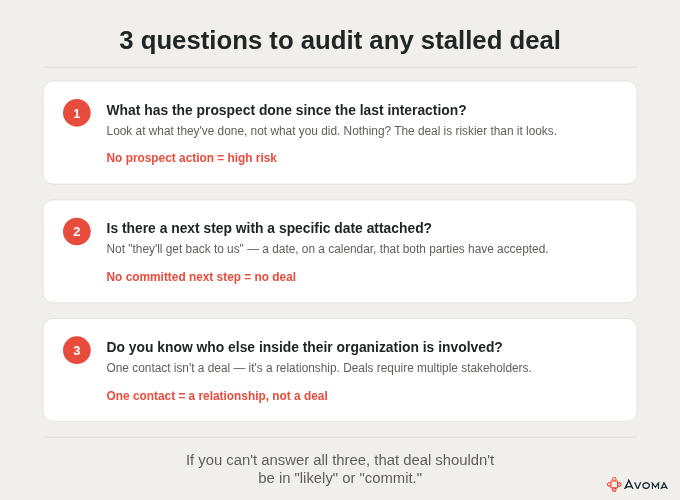
If the prospect has taken little action, there is no dated next step, and the deal still depends on one contact, the opportunity may be weaker than the CRM suggests. Requalify it before carrying it forward.
Re-engage around what changed
When a meeting is declined, find out whether timing is the issue or something in the evaluation needs attention.
When a champion leaves:
"I was working with [champion] on evaluating [product] for [use case]. It looks like they may no longer be with the company. Who would be the right person to continue the conversation with? I'm happy to provide a quick summary of where things stood."
For larger deals that continue to drift, set a clear boundary and leave the door open for the prospect to restart when the initiative becomes a priority again.
Check deal health with Avoma
Avoma's Deal Health helps reps see where risk is building across active deals using the deal and engagement context already captured in Avoma.
Use it alongside the prospect-evidence audit to decide which deals need another look and where to focus the next conversation.
40+ talk tracks for key deal moments
Use this companion library when you need to advance your deal from discovery and trial management to stalled deals, pricing, negotiation, and closing.
The talk tracks are starting points. Adapt the language to the prospect, the deal context, and what has already been said.
Frequently Asked Questions


Dive into Our Latest
Avoma Insights.


What's stopping you from turning every conversation into actionable insights?


