
Gainsight vs ChurnZero: Which customer success platform fits your team in 2026

Table of Contents:
.jpg)
We suppose you're here because you are evaluating Gainsight and ChurnZero.
And probably the key questions in your mind are: Which is the better customer success platform for your team in 2026?
In that case, I assume either you are leading a customer success (CS) team, or one of your key goals is to improve net revenue retention and reduce customer churn at a fast-growing B2B organization.
This post compares the two customer success platforms on ease of use, product capabilities, pricing, and scalability, and closes with our recommendation on which platform fits which team.
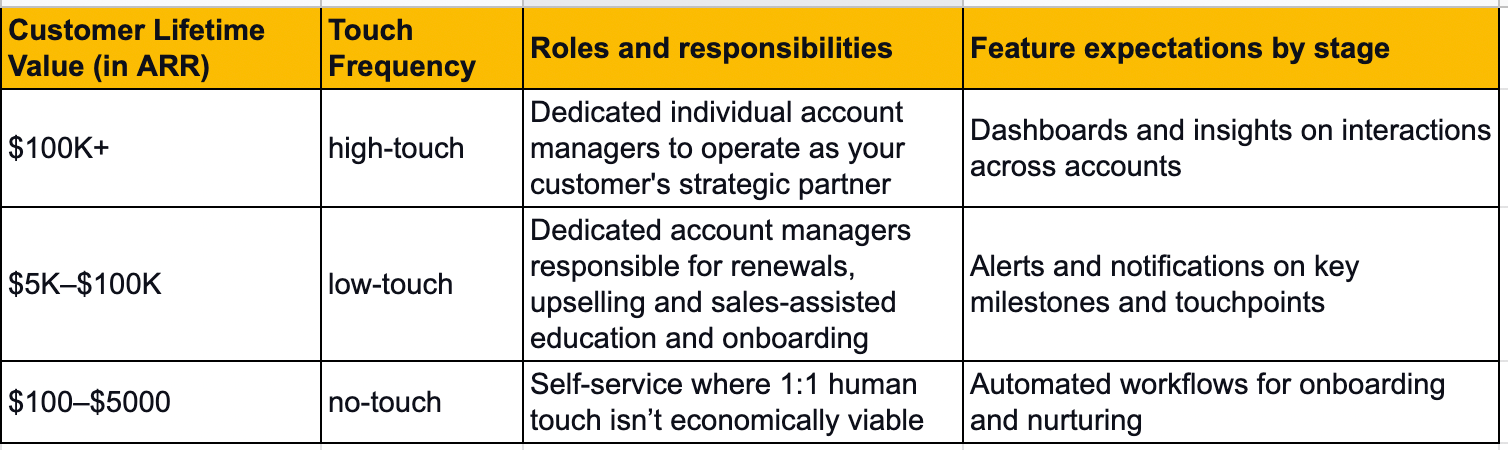
While selecting the right customer success software—know your organization's maturity stage. You need to know the revenue contribution by customers, i.e., who are your high-paying customers, how many of your customers are high-touch accounts, and more.
For instance, here’s an example of how to categorize customers and thereby prioritize the features you want in a CS software:
How we built this comparison
What makes us the authority to compare the two CS platforms and offer an objective and unbiased perspective? Great and a valid question!
At Avoma, we strongly believe in being useful and helpful to the SaaS community at large with our modern SaaS initiatives. In fact, we’ve gone through the CS software evaluation phase multiple times for our organization.
The purpose of this blog post is to not just share our learnings and observations from our evaluation journey, but also talk to several other evaluators, existing customers and past customers of both the tools.
Here’s the 5-step process on how we arrive at our comparative information in an unbiased manner:
- If we’ve evaluated the platform for ourselves in the past—refer to the notes on why we decided to go through or not-go-through with the platform.
- Reaching out to at least 15 existing and past users of both platform’s users to understand their first-hand experience.
- Interview the current and past users of these software to understand the nitty-gritties of the features that are a must-have, good-to-have, or missing.
- Aggregate a minimum of 100 reviews across G2, GetApp, TrustRadius, FinancesOnline and all relevant SaaS review sites to understand the customer sentiment at scale.
- Run polls on social media.
Gainsight vs ChurnZero at a glance
Gainsight lets you define the measure of customer health
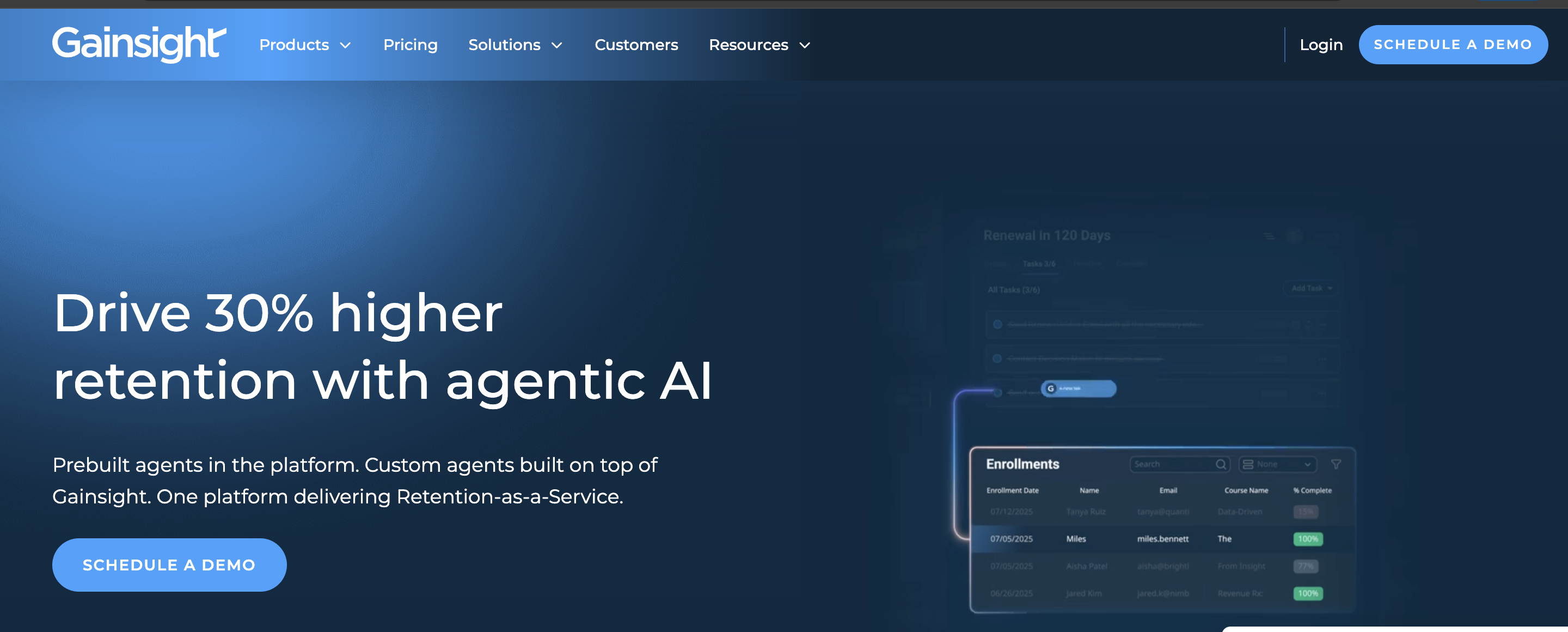
Gainsight has expanded beyond the core Customer Success product. It now organizes its offering under a Customer OS strategy: Gainsight Customer Success (Customer 360, Health Scorecards, Playbooks, Success Plans), Staircase AI (reads emails, meetings, and support tickets for sentiment and risk signals), and Atlas AI Agents (autonomous agents for adoption, renewal, and account monitoring). Gainsight also acquired Skilljar for customer education and onboarding in April 2025, and added Customer Communities and Product Experience for in-app engagement.
Gainsight also gives you the ability to monitor customer health only based on real-time usage. If you wish to include survey findings, invoice history, support history, and other variables in your scoring model, the platform is adaptable enough to allow you to do so.
If more than just real-time usage data is desired, you can extract multiple kinds of health-related data, including support tickets, product usage, survey results, NPS ratings, billing, and more, making Gainsight more appealing to enterprise organizations.
- Dan Steinman,Chief Evangelist at Gainsight
Gainsight provides dashboards for product usage, it recommends you to think about additional aspects that influence customer health, such as:
(a) How frequently do customers contact support?
(b) Do you get referrals from your current customers?
(c) Do your consumers participate actively in the community?
(d) What is your billing history like, and so forth.
Gainsight is positioned for mature SaaS companies having varied approaches to measuring customer health.
ChurnZero focuses on real-time churn signals
ChurnZero's foundation has stayed the same: a real-time customer success platform that catches churn risk early so teams can act on it. Its Command Center gives CS teams a single workspace for account health, renewal dates, tasks, and alerts, without needing a separate reporting tool
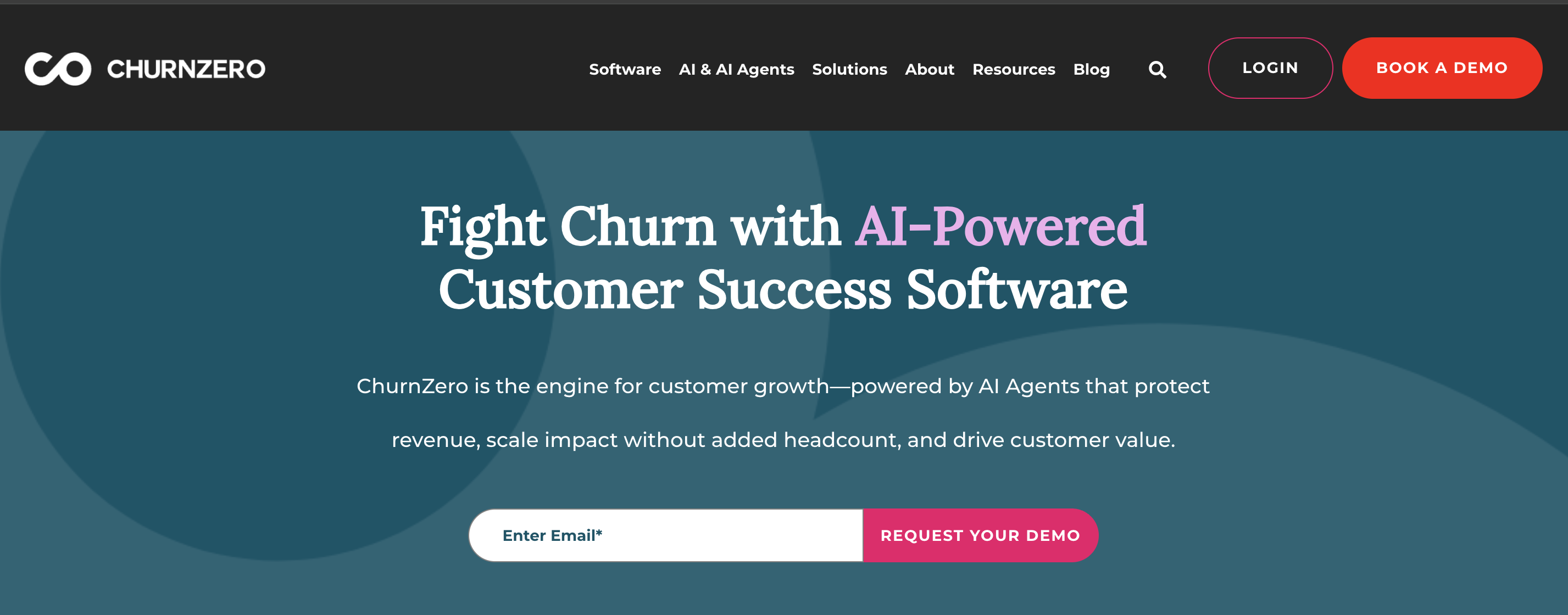
The ability to integrate with CRMs to streamline the customer success (CS) workflow is one of ChurnZero's key features. ChurnZero takes a similar strategy to Totango, which we described in our earlier comparison with Gainsight, with the main goal to:
- Understand how their customers use their product
- Assess their health and their chances of renewal
- Automate and personalize the customer experience with timely and relevant touchpoints, including in-app content
ChurnZero is positioned for mid-market and enterprise SaaS companies focused on reducing churn and improving product adoption. They launched Agentic Essentials which is built around over 15 purpose-built agents, an AI Marketplace, a Customer Intelligence Profile, and ChurnZero Connect. These agents draft follow-ups, surface next-best actions, and in approved workflows take action on their own.
Gainsight and ChurnZero
When you are evaluating between two or more SaaS products, it’s best to slice and dice your comparison from 4 critical lenses:
Key factors for evaluation
1. Ease of use
The ease of using a customer success platform is an essential factor to consider since it will make or break the platform's adoption among your CS team.
Questions to ask:
- How hard or easy is it to set up and implement the CS software?
- Do you need a dedicated manager to administer the tool?
- Can you trial the platform yourself with some automated nurture assisting you?
- Will the users need training to start using the tool effectively?
2. Product capabilities
If the CS software’s UX gets a passing grade, the next evaluation criteria should be the range of features and benefits it offers.
Questions to ask:
- How comprehensive is the platform in terms of allowing flexibility based on various customer success goals and approaches?
- What integrations does it support?
- Do they support the integrations natively or via some third party API connectors?
- Are its functionalities out-of-the-box or customizable?
3. Pricing
Pricing is an important area to explore considering your team size, budget, and the net retention revenue goals you expect to achieve as a result of leveraging the CS platform.
Questions to ask:
- Does the CS tool offer a free trial or freemium subscription model?
- Is the pricing affordable, flexible, and fair for your business use cases?
- Does it have flexible monthly billing options or does it force you to sign annual contracts?
- Are there any hidden costs?
4. Scalability
When you're buying a piece of software, you're not just buying to solve your pressing needs today but also looking to use it for your future needs.
Questions to ask:
- How easy and affordable is it to add more users to the platform?
- Does it offer enterprise-level features?
- Can the platform support you across the growth and maturity phases?
Comparing Gainsight and ChurnZero
1. Ease of use
Gainsight
Gainsight holds a 4.5/5 rating on G2 across roughly 1,745 reviews. Reviewers frequently cite strong centralized customer data and collaboration features.
ChurnZero
ChurnZero holds a 4.7/5 rating on G2 across more than 1,500 reviews, and earned Leader status again in G2's Spring 2026 Grid Report for Customer Success. In that report, ChurnZero posted a satisfaction score of 96 and a Net Promoter Score of 89, with 96% of reviewers saying the platform is easy to do business.
2. Product capabilities
Gainsight’s approach
Gainsight considers customer health to be a holistic measure that is influenced by a variety of factors such as product adoption, the amount of support cases raised over time, referrals from existing customers, and more.
When you're running a small business, product adoption and usage metrics are perhaps the most important measures of consumer health. However, we frequently hear from VPs of Customer Success at pretty large companies that consumption analytics alone do not provide a comprehensive picture of customer health.
Here’s what Gainsight for Customer Success looks like:
With features like Scorecards, Customer 360, and Timeline—you get a complete overview of your customer health (not just in terms of product usage, but also in terms of the number of interactions, bill payments, referrals, community participation, etc.) and can set up a workflow to drive the right action at the right moments across the customer success pipeline.
These pipelines can be used in order to understand exactly where a customer is in the process of being supported by a CS person and the next course of action. Also for a CS leader, this pipeline visibility is very helpful for internal reviews and to discuss how best to operationalize customer success in the most efficient and effective way.
ChurnZero’s approach
ChurnZero is focussed on minimizing churn, as the name implies. The platform provides a quick snapshot of account health, NPS, email and phone interactions, ongoing automated drip campaigns, and other indicators—making it a handy daily hub for customer service workflow.
ChurnZero lets you get a holistic understanding of customer health with a variety of features that let you measure how consumers use the product, the likelihood of renewal, and more.
With features such as Customer Segmentation, Account Insights, Plays, and Automations—the idea is to make customer interaction more proactive, trackable, and consistent. The platform helps you set up workflows to drive the right action at the right moments across the customer success pipeline.
Because the platform is aimed at the midmarket and enterprise customers, there is a lot of focus on process, integrations, and workflows. ChurnZero offer’s wide-ranging flexibility when it comes to integrating with CRMs to streamline the customer success workflow.
That said, the heavy dependency on integrations with CRMs and varied levels of configurations means you need a dedicated admin and focus on implementation, where you need to have all parties across the organization involved and on the same page.
3. Pricing
Both the tools have custom pricing. Gainsight names two tiers on its pricing page: Essentials, with 10 full users and 100 customers per user, and Enterprise, with 20 full users and 200 customers per user plus renewal and expansion forecasting and organizational mapping.
4. Scalability
Gainsight—scalability maybe subject to affordability
Gainsight users claim that it simplifies the work of managing various systems, both from an admin and user standpoint.
To create scoring and action plans for ‘customer health’ Gainsight can get data input from multiple sources. And since it is native to Salesforce, their significant advantage is—Gainsight can keep its data behind Salesforce’s firewall, which is a huge plus in terms of security making them a preferred choice for larger enterprise customers wanting to go the extra mile for security.
While the customers of Gainsight have great things to say about the platform, the only downside is—the pricing is not transparently available on the website.
Therefore at the outset, it's not very clear if you can crawl, walk, and run in terms of moving from a low-tier plan to a high-tier plan—based on your CS maturity curve.
ChurnZero–a safe and scalable bet
From the scale point of view, ChurnZero makes the task of managing multiple systems easier—from a user perspective, albeit the need for some support on the administrative side.
To reduce churn and improve your net retention rate, ChurnZero can get you data input from multiple sources. More importantly, it can help you with customer segmentation, automate several parts of your product-led workflow such as onboarding, improving product adoption, customer re-engagement and more.
ChurnZero too, like Gainsight, doesn’t share pricing on their website, and hence it’s not easy to qualify yourself in or out without talking to their sales team.
Final verdict
Both Gainsight and ChurnZero are strong customer success platforms, and the right pick depends on your CS maturity and existing tech stack.
Choose Gainsight if your CS process already tracks multiple health signals, your team runs on Salesforce, and you are managing 500 or more accounts. You will get the most value from its Health Scorecards, native Salesforce security model, and the option to add Skilljar or Customer Communities as you grow.
Choose ChurnZero if you are a fast-growing mid-market team that wants one daily workspace for account health, renewals, and CS activity, without needing to stitch together a broader customer education or community platform. Its Command Center and Agentic Essentials agents are built for teams that want to move fast with a smaller CS headcount.
Whichever platform you choose, pair it with a way to capture what customers say on calls in meeting summaries and activities. Health scores built only on logged CRM fields will lag behind what your customers tell you on calls.
Frequently Asked Questions


Dive into Our Latest
Avoma Insights.


What's stopping you from turning every conversation into actionable insights?


